HackUnion Engineering Journal
Events & Experiences
7 min read
OpenBuild Week: A Week Dedicated to Building
There's a specific gap between wanting to learn something and actually building with it. OpenBuild Week exists to close that gap - by giving people a week, not an hour, to move from intention to something real.

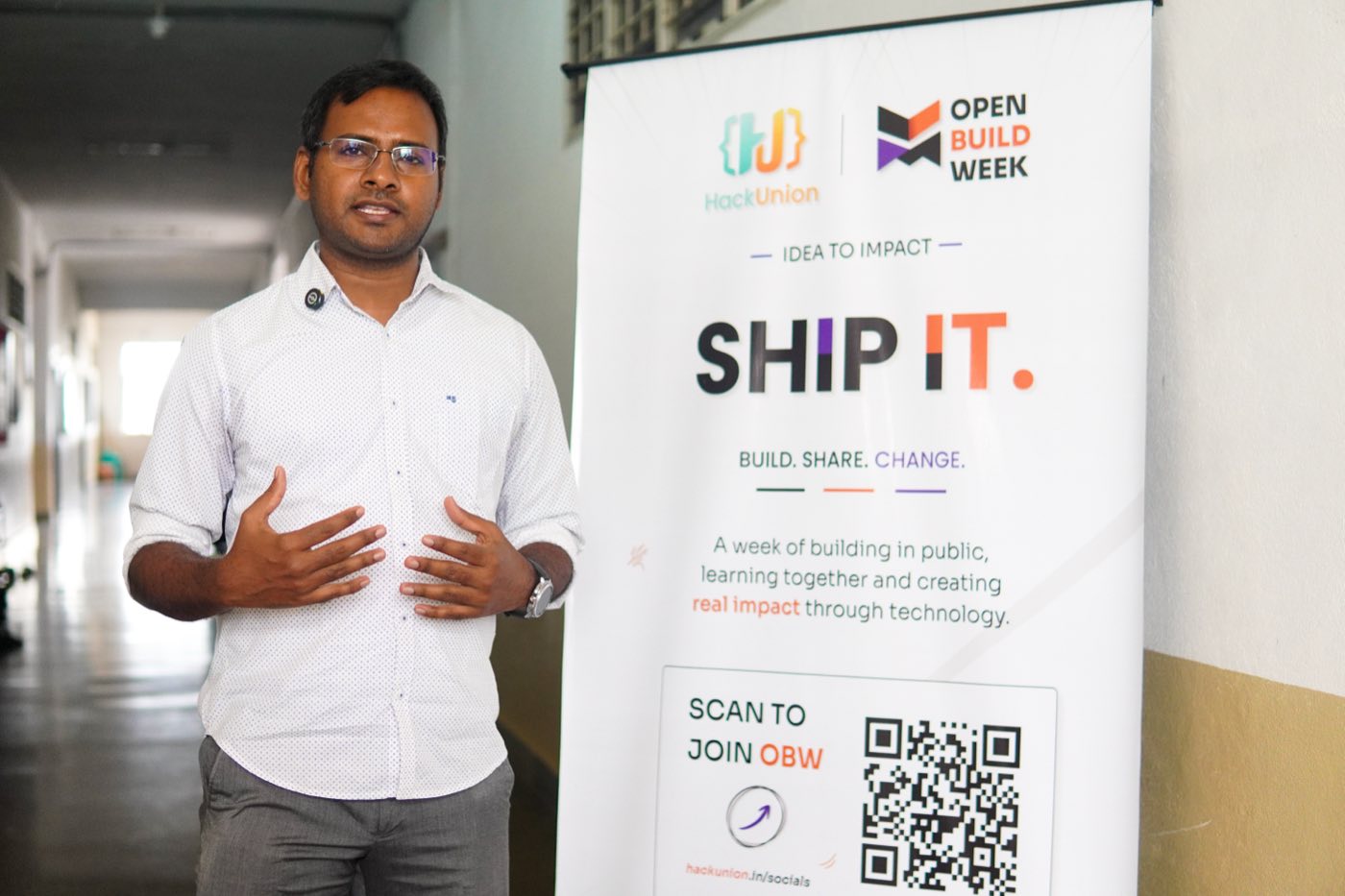
There’s a familiar moment a lot of students and early builders go through. You watch a tutorial, read a few docs, maybe finish a course - and you feel like you understand something. Then someone asks, so what did you build with it? and the honest answer is: nothing yet. The knowledge is there. The thing that would prove it isn’t.
OpenBuild Week is built around closing that specific gap - the one between I want to learn this and I’m going to build something with it.
What OpenBuild Week Actually Is
At its core, OpenBuild Week is a stretch of time - a full week - set aside for building. Not for attending sessions about building, not for watching other people build, but for actually sitting down and making something, with a community around you while you do it.
It’s less a single event and more a container. Inside that container, participants work on their own projects - software, AI experiments, websites, tools, open-source contributions, prototypes, creative technology projects, anything that counts as making something - with access to peers, mentors, and a general sense that this week, building is the expected activity, not an exception to the routine.
The name reflects the idea directly. It’s a week dedicated to building, and it’s open - open to different skill levels, different kinds of projects, and different starting points. There’s no single correct thing to build during OpenBuild Week. There’s just an expectation that you’re making something rather than only learning about making something.
Why a Week, Not a Few Hours
A hackathon compresses building into an intense, short burst - usually a day or two, sometimes a weekend. That format is valuable, but it’s not the only useful one. Compression works well for testing how fast you can build under pressure. It works less well for people who want to explore a technology more slowly, iterate on an idea, or simply need more than a few hours to get comfortable enough to start.
A week changes the shape of what’s possible. There’s room to try something, realize it’s the wrong approach, and pivot without the whole project collapsing. There’s room to ask a question on day two and actually apply the answer by day four. There’s room for a project to go from a rough idea to something that actually runs, without the specific kind of panic that comes from a ticking hackathon clock.
It’s not that a week is better than a hackathon - it’s a different kind of pressure, suited to a different kind of building. Some people do their best work in a sprint. Others need the week.
Who It’s For
OpenBuild Week isn’t aimed at experienced developers only, and it isn’t aimed at beginners only. It’s aimed at anyone willing to build something, regardless of where they’re starting from.
That includes a student writing their first real project outside of coursework. A developer who wants to spend a week experimenting with an AI tool they haven’t had a reason to use professionally. A designer prototyping an interface instead of just mocking one up. Someone making their first open-source contribution. Someone with an idea they’ve been sitting on, finally giving it a defined block of time to exist.
None of these require prior experience with hackathons, formal project management, or even much confidence. The starting requirement is smaller than people expect: a willingness to make something, even if it’s small or unfinished by the end of the week.
What Building Means Here
It’s worth being direct about this, because the word build tends to get inflated into something that sounds bigger than it needs to be. Building, in the context of OpenBuild Week, doesn’t mean launching a startup or shipping a polished application.
A build can be a small software project. An experiment with an AI model or API you’ve never used. A personal website. A tool that solves one specific, small problem you’ve personally run into. A contribution to an existing open-source project - even a modest one. A prototype that only half-works. A creative project that uses technology in an unconventional way.
The size of the thing matters far less than the fact that it exists by the end of the week, and that you made it. A small, working thing you built yourself teaches you more than a large, ambitious thing that only exists as an idea.
The Open in OpenBuild
Open runs through the week in a few overlapping ways, more as a working philosophy than a fixed definition.
It means open participation - you don’t need a specific background or skill level to take part. It means open learning - figuring things out in the open, including the parts where something doesn’t work the first time. It means sharing progress and ideas with people around you instead of building in isolation, and being willing to learn from what other people are working on, not just your own project. And it means a general spirit of experimentation - trying an approach without being certain it’ll work, because the week is structured to allow for that kind of exploration rather than punishing it.
None of this requires you to make your project public or fully open-source, though some participants choose to. The open is mostly about the process - building visibly, alongside others, rather than quietly and alone.
Why This Works Especially Well on Campus
Students already spend a significant amount of time learning concepts - that’s what most of a curriculum is built for, and it does that well. What’s often missing isn’t knowledge, it’s a dedicated stretch of time and a supportive environment to actually apply it to something self-directed.
OpenBuild Week, brought onto campuses, creates a different kind of space alongside that existing academic structure - not a replacement for it. During the week, students get room to experiment without being graded on the outcome, work alongside peers who are tackling different kinds of projects, ask questions they might not raise in a classroom setting, make mistakes without real consequences, get feedback on something they made rather than something they were assigned, and meet people outside their usual immediate circle - other students, mentors, developers, industry professionals who show up specifically to be part of this different kind of week.
This is meant to sit alongside classroom learning, not in competition with it. A curriculum gives you the concepts. A week like this gives you a low-stakes place to actually use them.
Collaboration, Mentors, and Community
Building during OpenBuild Week doesn’t have to be a solitary activity, even for an individual project. Peers working nearby, mentors dropping in to answer questions, developers and industry professionals sharing how they’d approach a problem - all of this is part of what makes the week different from working through a tutorial alone at home.
Mentors and professionals aren’t there to lecture. Their role during the week tends to be more direct and situational - helping someone get unstuck, offering a perspective on a decision, or just being available for the kind of question that’s hard to Google well. That access, even informally, tends to matter more than any single piece of advice.
How It’s Different From a Typical Tech Event
Most technology events are organized around content delivery - talks, panels, demos of things other people built. OpenBuild Week flips the orientation. The content is secondary. The point is the making. Anything else during the week - a mentor session, a short talk, a discussion - exists to support the building, not to replace it.
That’s the core difference worth understanding: a typical event asks you to pay attention. OpenBuild Week asks you to produce something.
What Participants Take Away
Ideally, by the end of the week, someone has something they didn’t have at the start - a project, a prototype, a contribution, an experiment that mostly works. Alongside that, they usually come away with something less tangible: a clearer sense of what they’re capable of building when they’re given the time and the room to try, and a set of people - peers, mentors, other builders - they met in the process.
None of that requires the project to be impressive by outside standards. It requires the project to exist, and to have been made by them.
Stop Waiting Until You’re Ready
A lot of people delay building because they don’t feel ready yet - like there’s more to learn first, more preparation needed before starting counts as legitimate. OpenBuild Week is, in a quiet way, a pushback against that instinct. It offers a week where the only real expectation is that you try - not that you already know how it’ll turn out.
Sometimes the only thing standing between wanting to build something and actually building it is a block of time, a bit of encouragement, and people around you doing the same thing. That’s most of what OpenBuild Week is trying to provide.